.png)
The Day the Giant Fell
Four World Cup holders. Four group-stage exits. One repeating warning sign.
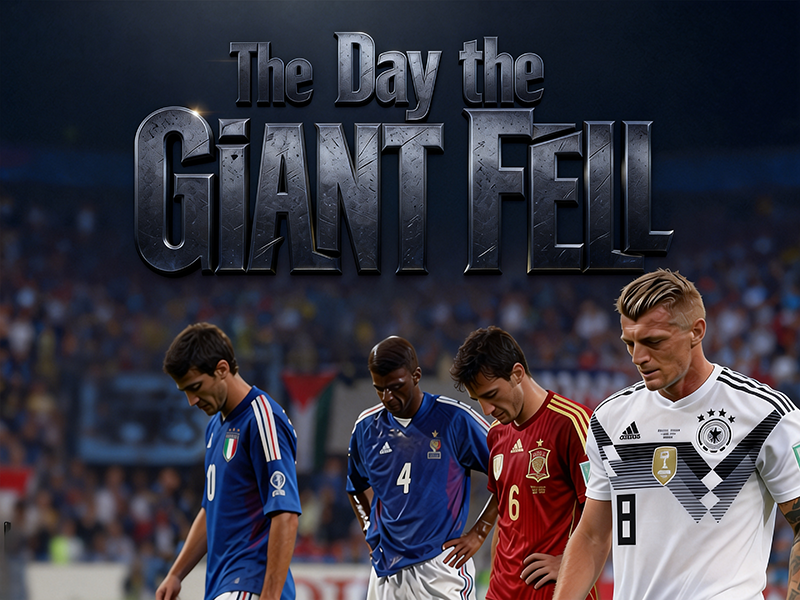
There is a particular kind of silence that follows a champion’s collapse. Not the roar of an upset, but the stunned pause afterward—the moment you see elite players staring into the middle distance, hands on heads, trying to process a reality they never planned for. The images you shared capture that feeling perfectly: the posture of disbelief, the heavy legs, the empty look that says this wasn’t supposed to happen.
Between 2002 and 2018, the World Cup produced a brutal pattern: the reigning champions—supposedly football’s most complete teams—fell at the first hurdle. France in 2002. Italy in 2010. Spain in 2014. Germany in 2018. Different eras, different squads, different styles… and yet the same ending.
This is the story of those four tournaments—and what their collapses had in common.
2002: France — When the engine stopped
France arrived in Korea/Japan as champions and, on paper, looked like a team built to dominate again. Instead, they crashed out in Group A, finishing bottom behind Denmark, Senegal and Uruguay.
What went wrong wasn’t just one bad match—it was a complete breakdown of fluency. The champions looked strangely blunt: slow circulation, minimal penetration, and an inability to recover emotionally once the tournament didn’t start smoothly. Group football punishes this more than people realise. A knockout match gives you a “reset” after a poor 30 minutes. A group doesn’t. Every dropped point turns into pressure, and pressure turns into caution, and caution turns into sterile possession.

France’s failure in 2002 became the template for what followed: a champion arriving with reputation, only to discover that reputation doesn’t score goals.
2010: Italy — A draw isn’t harmless when you’re vulnerable
Italy’s title defence ended in Group F, where they failed to finish in the top two and were eliminated.
Italy’s group-stage story is a lesson in how not losing can still be losing. When a defending champion comes in with a risk-managed mindset—protecting shape, waiting for the “real tournament” to begin—group football doesn’t always allow it. The moment you drop points early, every next decision becomes conservative: fewer runners, fewer risks, fewer shots, fewer goals. And once goals dry up, one swing game decides everything.

The other hidden problem is emotional tempo. Champions often start slowly because their tournament is built around control. But control becomes hesitation when opponents play like they have nothing to lose.
2014: Spain — The old map no longer matched the territory
Spain landed in Brazil as defending champions in the “group of history”: Group B contained both 2010 finalists—Spain (holders) and the Netherlands (runners-up)—plus Chile and Australia. Spain were eliminated after losing their first two matches.
Spain’s collapse wasn’t simply decline—it was a tactical world catching up. Their approach depended on two things:
the ability to dictate rhythm, and
opponents’ patience (or fear).
By 2014, opponents had stopped waiting. They pressed harder, transitioned faster, and attacked the spaces behind Spain’s advanced positioning. In a group, there is no time to “adjust across rounds.” Two defeats and you’re gone.

Spain’s failure also illustrates a key theme of these collapses: tactical identity becomes tactical rigidity when the environment shifts. The very system that made you champions becomes a trap if you can’t change gears instantly.
2018: Germany — When certainty turns into entitlement
Germany’s exit in Russia shocked the world not only because it happened, but because of how familiar it looked: heavy favourites, struggling for rhythm, chasing the game, and running out of time. In Group F, Germany were eliminated while Sweden and Mexico advanced.
The group itself tells the story: Germany were defending champions, but finished outside the top two. The Wikipedia summary even notes how historically rare Germany’s early exit was, underlining the scale of the surprise.

Germany’s 2018 lesson is about mindset as much as tactics. When a champion concedes first—or fails to win early—the tournament becomes a test of emotional flexibility. Teams that think “we always find a way” often keep playing as if time is unlimited. But group football is time in a bottle: three matches, and one bad half can distort the entire table.
The common pattern: how champions fall in the group stage
Across all four collapses, the shared causes weren’t mysterious. They were repeatable—and therefore avoidable.
1) Slow start + rising pressure = tactical shrinkage
Champions often begin with caution: keep structure, avoid chaos, grow into the tournament.But when the first result disappoints, the response is rarely liberation—it’s tightening. Safe passes. Fewer runners. Lower risk. Lower chance creation. That’s when the “champion aura” becomes a burden.
2) Opponents play “final” football—champions play “opening-round” football
For the underdog, facing the holders is a once-in-a-career moment. They sprint, duel, press, shoot early, and celebrate every tackle. For the champions, it’s match one of seven. That mismatch in urgency is fatal.
3) Identity becomes rigidity
France lost fluency. Italy leaned too hard into control. Spain’s dominance model met a new tactical world. Germany trusted inevitability. Different details, same structural flaw: when Plan A stalls, Plan B arrives too late.
4) Group-stage math is cruel
In knockout rounds you can survive with one great night. In groups you need baseline reliability—points accumulation. A single draw can become a trap. One loss creates a must-win. And must-win games are the hardest games psychologically.
The Real Lesson for Future Holders
These four collapses ultimately point to the same truth:the World Cup group stage is no longer a prelude to the knockouts — it is the knockout.
For defending champions, the greatest danger is not a sudden loss of quality, but a subtle psychological misalignment.When holders approach the group stage as a phase for management, adjustment, or controlled risk, their opponents arrive treating every minute as an elimination battle.That imbalance in urgency often proves more decisive than any tactical mismatch.
Modern World Cups offer no margin for gradual awakening.Spaces are tighter, tempos are faster, and the cost of hesitation is immediate and unforgiving.In such an environment, assumptions of “form will come later” or “there will be time to recover” are brutally exposed by the standings.
The lesson itself is simple — and relentlessly demanding:a defending champion must play the group stage with a knockout mentality.Establish control from the first match, secure safety in the second, and remain ruthless in the third.The title does not shield a team; it marks them as a target.
From France in 2002 to Italy in 2010, Spain in 2014, and Germany in 2018, history has delivered the same verdict through different failures.And the absence of this collapse after 2018 is no coincidence.It reflects adaptation, not the lifting of a curse.
The World Cup makes no allowance for past glory.It rewards only those champions willing to treat every group-stage night as if it were their last.


Comments